
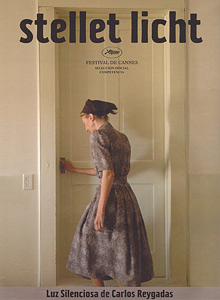
Silent Light (Luz silenciosa) (Director: Carlos Reygadas): Another one of my previewed films that made the final cut, Silent Light is a bit intimidating to write about. Beginning with a stunning six minute shot of the sun rising over a Mennonite homestead, the film alerts us that it is going to require patience and a certain sense of contemplation. And it establishes right away that everything that follows, the human story, is secondary to the cycles of nature, to the circadian rhythms of the natural world, to the pulse of life that beats deep down in the earth and that echoes throughout the universe. I’m sorry if I’m using high-flown language; it’s the effect of this strangely haunting film.
Johan is a simple farmer who’s lived his whole life among the Mennonites of northern Mexico. They don’t communicate much with outsiders, and speak their own Plautdietsch dialect of German. He lives with his wife Esther (Canadian novelist Miriam Toews in a surprising role) and their large family. The film’s crisis comes when we learn that Johan has been carrying on an affair with Marianne, another woman in the community. He’s been honest about it with Esther from the beginning, and has tried to break it off, but deep in his heart he feels that Marianne is his “natural woman” and that marrying Esther was a mistake. Though he clearly loves her and his children, he’s torn by the power of his passion for the other woman as well as his conviction that she is his intended match. Reygadas’ decision to use authentic Mennonite non-professionals has mixed results. Though it’s clear that these are stoic people who use few words, in places the dialogue still felt excessively mannered. He is able to achieve more with the camera than with any spoken dialogue, and that’s where the film finds its emotional power.
The cinematography and sound design are almost Dogme-like in their simplicity, which makes the film’s climax all the more surprising for some. Without giving anything away, all I’ll say is that unlike many, I found it completely natural and moving in its simplicity. And although this is supposedly a community built on Christian faith, I found something closer to pantheism beating at its heart.
Here is the Q&A with director Carlos Reygadas from after the screening:
Duration: 23:58
 (8/10)
I think you’ve sold me on this one too James…After our chat the other night I mentioned the film to my wife and she was very curious to see it. Both the subject matter as well as Miriam Toews’ involvement were big reasons. She really enjoys her fiction books, but also was very much taken by her accounts of growing up in Canadian Mennonite communities.
I thought this was a fabulous film but I find the ending a little frustrating. The more I think about it the more I dislike the ending.
That aside, this is a beautiful looking film. The artistry behind the framing, the use of colour and the composition in each scene is incredible. If you appreciate landscape photography at all then you’ll love the visual element of this film.
Just wanted to jump in and let Torontonians know that the film is finally opening theatrically at the Royal on Friday July 11th. Not sure how long it will be there, so plan to see it that first weekend before this gorgeous and moving film disappears.